Implementing Cardano’s Rule
Vector 8:4, page 43
Transcribed from the printed issue; not yet reviewed. Read it in the PDF of the issue, page 43
A cubic equation with derived forms
Let us be given the equation
Dividing by \(A\) leads to its normal form
where
Substituting \(x = y - \frac{a}{3}\) finally renders the reduced form
where
and
Cardano’s rule
Define the discriminant by
Further let
and
Depending on the sign of \(\Delta\) Cardano’s rule distinguishes three cases to solve the reduced form, [1].
-
\(\Delta < 0\) (casus irreducibilis): The three real solutions are
\[\begin{align*} y_1 &= 2\sqrt{\frac{|p|}{3}}\cos\frac{\phi}{3} \\ y_2 &= -2\sqrt{\frac{|p|}{3}}\cos\left(\frac{\phi - \pi}{3}\right) \\ y_3 &= -2\sqrt{\frac{|p|}{3}}\cos\left(\frac{\phi + \pi}{3}\right) \end{align*}\]where
\[\begin{equation*} \phi = \arccos\left(\frac{-\dfrac{q}{2}}{\sqrt{\left(\dfrac{|p|}{3}\right)^3}}\right) \end{equation*}\] -
\(\Delta = 0\): There are three real solutions, two of them being identical. They are given by
\[\begin{align*} y_1 &= u + v \\[3ex] y_{2,3} &= -\frac{u + v}{2} \end{align*}\] -
\(\Delta > 0\): There is one real solution and two complex ones. They are given by
\[\begin{align*} y_1 &= u + v \\[3ex] y_2 &= -\frac{u + v}{2} + \frac{\sqrt{3}}{2}(u - v)i \\[3ex] y_3 &= -\frac{u + v}{2} - \frac{\sqrt{3}}{2}(u - v)i \end{align*}\]
The program CARDANO can be used to get the solutions of any cubic equation.
Approximating \(\Phi^{-1}(p)\)
Let \(\Phi\) be the distribution function of a standard normal distribution, i.e.
Recently, Derenzo [2] and Lin [3] considered approximations to \(\Phi(z)\). Derenzo established the approximation
where
see also [4].
Lin’s method amounts to
with
Its advantage is the fact that a simple formula is available to approximate \(z_p\) with \(\Phi(z_p) = p\). It is given by
where \(a(p) = -\ln(2(1 - p))\).
Inverting Derenzo’s formula is not so obvious, since for \(p > 0.5\) we have to solve
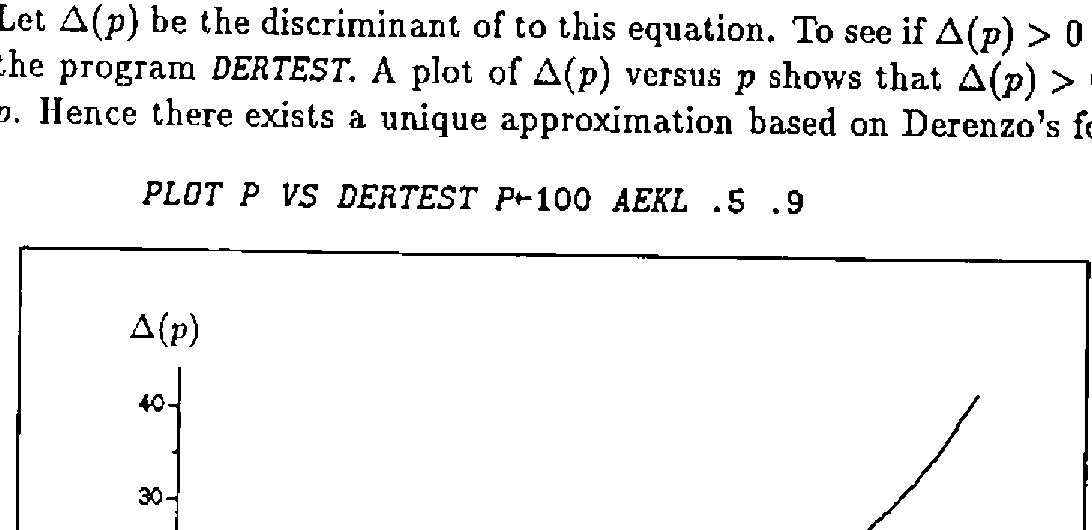
Let \(\Delta(p)\) be the discriminant of to this equation. To see if \(\Delta(p) > 0\) we used the program DERTEST. A plot of \(\Delta(p)\) versus \(p\) shows that \(\Delta(p) > 0\) for all \(p\). Hence there exists a unique approximation based on Derenzo’s formula.
The program IDERENZO computes the approximation \(z_{pD}\) for a vector of values \(p \in (0,1)\).
Although inserting Derenzo’s values in Cardano’s rule leads to a very clumsy formula its implementation is straightforward and yields excellent results as can be seen by comparing it to Lin’s method. The following table corresponds to that in [3] although values \(p\) greater than .9995 have been taken into account. It reveals the fact that the absolute relative error \(rz\) of the new approximation is never greater than 0.34% for all values of \(p\).
| \(p\) | \(z_p\) | \(z_{pD}\) | \(z_{pL}\) | \(rz_D\) (%) | \(rz_L\) (%) |
|---|---|---|---|---|---|
| 0.500000 | 0.000000 | 0.000000 | 0.000000 | 0.000000 | 0.000000 |
| 0.600000 | 0.253347 | 0.253261 | 0.269179 | 0.033907 | 6.249075 |
| 0.700000 | 0.524401 | 0.524515 | 0.542005 | 0.021740 | 3.357063 |
| 0.800000 | 0.841621 | 0.841877 | 0.854404 | 0.030447 | 1.518867 |
| 0.900000 | 1.281552 | 1.281774 | 1.285662 | 0.017374 | 0.320770 |
| 0.950000 | 1.644854 | 1.644962 | 1.643760 | 0.006618 | 0.066510 |
| 0.975000 | 1.959964 | 1.959978 | 1.956721 | 0.000701 | 0.165453 |
| 0.990000 | 2.326348 | 2.326287 | 2.323588 | 0.002614 | 0.118620 |
| 0.995000 | 2.575829 | 2.575744 | 2.575194 | 0.003311 | 0.024658 |
| 0.997500 | 2.807034 | 2.806943 | 2.809597 | 0.003233 | 0.091325 |
| 0.999500 | 3.290527 | 3.290463 | 3.303295 | 0.001931 | 0.388044 |
| 0.999750 | 3.480756 | 3.480712 | 3.498733 | 0.001275 | 0.516455 |
| 0.999900 | 3.719016 | 3.718998 | 3.744378 | 0.000496 | 0.681953 |
| 0.999950 | 3.890592 | 3.890592 | 3.921829 | 0.000010 | 0.802889 |
| 0.999975 | 4.055627 | 4.055642 | 4.092928 | 0.000374 | 0.919743 |
| 0.999995 | 4.417173 | 4.417211 | 4.469071 | 0.000858 | 1.174914 |
References
[1] Bartsch, H.J. (1971) Mathematische Formeln, Buch- und Zeit-Verlagsgesellschaft mbH, Köln.
[2] Derenzo, S.E. (1977) Approximations for Hand Calculators Using Small Integer Coefficients, Mathematics of Computation 31, 214-225.
[3] Lin, Jinn-Tyan (1989) Approximating the Normal Probability and its Inverse for Use on a Pocket Calculator, Appl. Statist. 38, 69-70.
[4] Velleman, P.F and Hoaglin, D.C. (1981) Applications, Basics, and Computing of Exploratory Data Analysis, Duxbury Press, Boston.
Appendix: The Programs
∇Δ←DERTEST p;AP;A;B;C;D;P;Q;a;b;c;Δ
[1] AP←-⍟2×1-p
[2] A←83 ⋄ B←351 ⋄ C←562-165×AP ⋄ D←¯703×AP
[3] a←B÷A ⋄ b←C÷A ⋄ c←D÷A
[4] P←b-a×a÷3 ⋄ Q←c+(÷27)×(2×a*3)-9×a×b
[5] Δ←((Q÷2)*2)+(P÷3)*3
∇

∇R←IDERENZO p;a;b;c;p;q;D;u;v;A
[1] A←-⍟2×1-p
[2] a←351÷83 ⋄ b←(562-165×A)÷83 ⋄ c←¯703×A÷83
[3] p←b-(a×a)÷3
[4] q←c+((2×a*3)-9×a×b)÷27
[5] D←(0.25×q×q)+(p÷3)*3
[6] u←(×u)×(|u←(¯0.5×q)+D*0.5)*÷3
[7] v←(×-v)×(|v←(0.5×q)+D*0.5)*÷3
[8] R←u+v-a÷3
∇

∇R←CARDANO ABCD;a;b;c;p;q;D;u;v;f
[1] a←ABCD[2]÷ABCD[1]
[2] b←ABCD[3]÷ABCD[1]
[3] c←ABCD[4]÷ABCD[1]
[4] p←b-(a×a)÷3
[5] q←c+((2×a*3)-9×a×b)÷27
[6] a←-a÷3
[7] →( ¯1 0 1=×D←(0.25×q×q)+(p÷3)*3)/DS0,DE0,DG0
[8] DS0:'Three real solutions:'
[9] R←2○f←(¯2○(¯0.5×q)×((|p÷3)*3)*¯0.5)÷3
[10] R←a+(2×(|p÷3)*0.5)×R,-2○f+ ¯1 1 ×○÷3
[11] →0
[12] DE0:'Three real solutions (two identical):'
[13] R←a+(-u+u),R,R←u←(0.5×q)*÷3
[14] →0
[15] DG0:'Two conjugate complex and one real solution:'
[16] u←(×u)×(|u←(¯0.5×q)+D*0.5)*÷3
[17] v←(×-v)×(|v←(0.5×q)+D*0.5)*÷3
[18] R←u+v+a
[19] (⍕a-0.5×u+v),' + ',(⍕(0.5×3*0.5)×u-v),'i'
[20] (⍕a-0.5×u+v),' - ',(⍕(0.5×3*0.5)×u-v),'i'
∇